
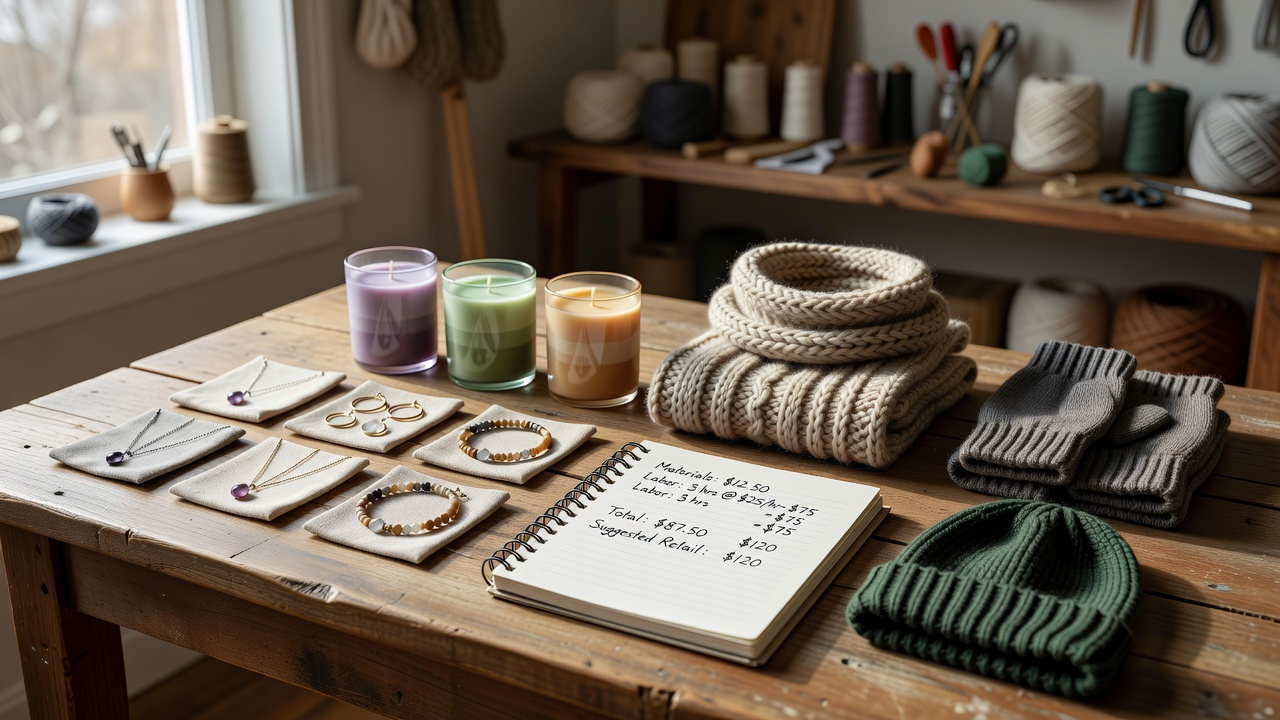
How to Price Handmade Products for Profit: Complete Guide
Imagine pouring hours into crafting a perfect handmade candle, only to sell it for $10 and barely cover your wax costs. Sound familiar? Thousands of Etsy sellers and Shopify store owners face this reality every day. Undervaluing your work turns passion into a grind, leaving profits on the table. This guide reveals how to price handmade products the right way, with a proven handmade pricing formula that ensures you thrive, not just survive.
Whether you make jewelry that sparkles, soaps that soothe, or crochet pieces that cozy up homes, pricing sets the foundation for your business. We break it down step by step, with real numbers, examples, and tools built for seller decisions. By the end, you will master the craft pricing calculator mindset and price confidently for profit.
Why Handmade Sellers Undervalue Their Work
Craft makers often treat their creations like hobbies, slapping on prices that reflect material costs alone. Picture a woodworker spending weekends sawing intricate shelves, pricing them at $50 to undercut big box stores. Weeks later, exhaustion sets in, with no savings to show. This undervaluation stems from two core issues: the labor problem and the hobby mindset.
The Labor Problem: Time Slips Away Unpaid
Labor is your biggest hidden cost. Makers forget to clock every minute: sourcing supplies, prototyping, photographing, packing. A simple pair of earrings might take 45 minutes total, yet many price as if it took five. Result? You work for pennies per hour. Track time rigorously with a phone timer. Common mistake: ignoring "invisible" tasks like order fulfillment, which can double your effort.
The Hobby Mindset: Passion Blinds Profit
If crafting started as a weekend escape, pricing follows suit: low to attract buyers, high feels greedy. But shift to business owner. Etsy data shows top sellers price 2-3x hobby levels, earning six figures. Ask yourself: Would you pay your barista $2 an hour? No. Value your skill as professionals do. Overcoming this means embracing worth: your unique touch commands premium prices.
Undervaluing repels serious buyers who equate cheap with low quality. Price right, and watch sales of mugs, stickers, and art prints soar. Ready for the formula that fixes this?
The Handmade Pricing Formula Explained
The handmade pricing formula is simple yet powerful: Retail Price = (Materials + Labor + Overhead) x (1 + Profit Margin). This ensures every sale covers costs and builds wealth. Break it down with real components, tailored for craft makers.
Materials: Track Every Penny Spent
List direct costs: wax for candles, yarn for crochet, blanks for t-shirts. Include waste factor, like 10-20% extra for soap scraps or wood offcuts. Pro tip: Buy in bulk for discounts, but calculate per unit. Example: $4 wax, wicks, and jars for one candle. Use spreadsheets or our craft pricing calculator for instant tracking.
Labor: Value Your Time at Market Rate
Set an hourly wage: beginners $15-20, experts $30+. Time every step. Crochet amigurumi? 2 hours at $25/hour = $50 labor. Include design tweaks and skill premium. Undercount here, and you subsidize buyers. Formula: Hours x Rate.
Overhead: The Business Backbone Costs
Cover rent, utilities, tools, marketing, shipping supplies. Divide monthly totals by units sold. Home studio? $200/month overhead / 100 items = $2 per piece. Scale up sales, this drops. Track quarterly to adjust.
Profit Margin: Fuel Growth and Rewards
Aim 25-50%: 30% for most crafts. Multiplies base cost. $20 base x 1.3 = $26 retail. Reinvest or pocket it. Higher for custom work like woodworking heirlooms. Test with A/B listings on Etsy.
Plug into our tools for instant, transparent math. Built for seller decisions.
Worked Example: Calculate a Candle Price Step-by-Step
Let us apply the formula to a soy candle. Numbers make it crystal clear.
- Materials: $2 soy wax, $1 jar, $0.50 wick, $0.50 fragrance = $4 total. Added 10% waste.
- Labor: Melt wax (10 min), pour (10 min), label/cure/test (16 min) = 36 minutes or 0.6 hours. At $20/hour: 0.6 x 20 = $12.
- Overhead: Studio share, labels, packaging = $2 per candle.
- Base Cost: 4 + 12 + 2 = $18.
- Profit Margin: 30% or x 1.3 = 18 x 1.3 = $23.40. Round to $24 for appeal.
Transparent? Sell 100/month at $24: $2,400 revenue, $1,200 profit after costs. Compare to $12 "hobby" price: break-even at best. Use our candle pricing calculator to tweak yours.
Pricing for Different Product Types
Each craft has quirks. Adjust the formula for labor intensity, waste, and scalability. Link to specialized calculators for precision.
Jewelry Pricing: Precision and Materials Shine
High material costs (silver, gems) but short labor. Add 15% waste for filings. $10 materials + $10 labor (30 min at $20/hr) + $2 overhead x 1.4 = $32.80. Premium for custom. Try jewelry pricing calculator.
Soap Pricing: Batch Efficiency Lowers Costs
Lye, oils: $1.50/bar. Labor drops per bar in batches (20 min/10 bars). Waste high from failed mixes. Base $4 x 1.3 = $5.20. Soap pricing calculator handles batches.
Crochet & Knitting: Labor-Heavy Skill Premium
Yarn $8, 4 hours at $25/hr = $100 labor + $3 overhead x 1.4 = $155. Complexity adds value. Crochet or knitting pricing calculator.
Woodworking: Tool and Waste Factors
Lumber $15, 3 hours $30/hr = $90 + $5 overhead (sander wear) x 1.35 = $149.25. Durability justifies premium. Woodworking pricing calculator.
T-Shirts: Print-on-Demand Hybrid
Blank $7, design labor $10 + $2 overhead x 1.4 = $26.80. Low ongoing labor. T-shirt pricing calculator.
Mugs: Sublimation Setup Costs
Blank $4, vinyl $2, 20 min labor $7 + $1.50 overhead x 1.3 = $18.95. Scale with bulk. Mug pricing calculator.
Stickers: Low Cost, High Volume
Vinyl sheet $0.20 each, design $5 amortized + $0.50 overhead x 1.5 = $3.45/pack. Digital leverage. Sticker pricing calculator.
Art Prints: One-Time Art, Repeat Sales
Print $3, original design labor $50/100 prints = $0.50 + $1 overhead x 1.4 = $6.70. Art print pricing calculator.
Baked Goods: Freshness and Perishability
Ingredients $2.50/cookie dozen, 1 hour $20 + $3 overhead (oven) x 1.25 = $32/dozen. Shelf life limits. Bakery pricing calculator.
Wholesale vs Retail Pricing
Retail fuels direct sales; wholesale scales via boutiques. Rule: Wholesale = 50% of retail MSRP (Manufacturer's Suggested Retail Price). Maintain margins.
Candle retail $24? Wholesale $12. Your cost $18? Loss. Recalculate base to ensure $12 covers costs + 20-30% profit. MSRP guides buyers. Minimum orders protect: 50 units. Track with formula: Wholesale Price = Retail / 2, adjust up if margins thin.
- Pros: Volume sales, exposure.
- Cons: Lower per-unit profit, returns risk.
- Tip: Tiered: 50% boutiques, 60% retailers.
Don't Forget Platform Fees
Fees eat profits silently. Build them in.
Etsy: 6.5% transaction + 3% + $0.30 payment + $0.20 listing. $24 sale: ~$2.13 fees. Add 10% buffer: Base x 1.1 before margin.
Shopify: Plans $29+/month + 2.9% + $0.30. Scale factor: ~8% average. Prorate subscription.
Adjusted formula: (Costs x 1.1 for fees) + margin. Use Etsy fee calculator or Shopify pricing calculator for instant, transparent math.
Final Checklist and Next Steps
Price like a pro:
- Track time and costs weekly.
- Run formula per product.
- Test prices: Raise 10%, monitor.
- Factor fees, wholesale.
- Review quarterly.
Ready to profit? Smart Sellers Tool offers free calculators for every craft above, plus 154 more e-commerce profit calculators. Built for seller decisions. Head to our calculators hub for instant, transparent math. Transform pricing today, watch your handmade empire grow.
Price not as a hobbyist, but as the artisan business you are.