
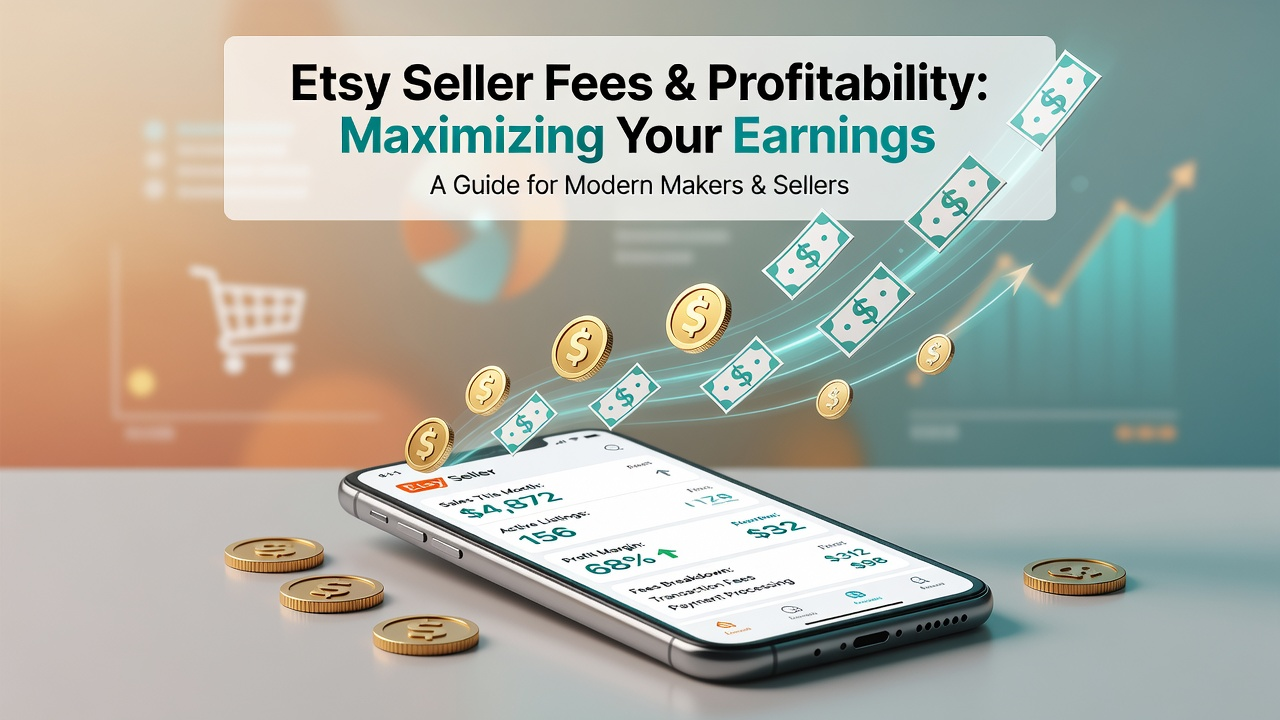
TL;DR: Etsy's Cut in 2026
Etsy seller fees typically total 10-15% of your sale without offsite ads, rising to 20-25% if ads drive the sale. Listing fees add $0.20 per item. Always calculate net profit after all Etsy fees, shipping, and costs to ensure true profitability.
Pro Tip: Plug your numbers into our free Etsy Fee Calculator for instant, transparent results.
Etsy Fees Explained: How Much Does Etsy Take From Your Sales? (2026 Guide)
Introduction
Imagine crafting a handmade necklace, pricing it at $25 based on materials and time, and celebrating a sale. But after Etsy fees, shipping deductions, and other costs, your actual take-home is barely half that. Many Etsy sellers focus on product costs alone, overlooking how Etsy seller fees erode profit margins. The real question is not "How much did I sell for?" but "How much money did I actually keep?"
In this definitive 2026 guide, we break down every Etsy fee with clear examples, calculations, and strategies. Whether you are a new shop owner or seasoned handmade seller, understanding Etsy fees unlocks true profitability. We cover listing fees, transaction fees, payment processing, offsite ads, and more, so you can price smarter and keep more of what you earn.
What Are Etsy Seller Fees?
Etsy charges five primary types of seller fees in 2026, each designed to cover platform operations, payments, and marketing. These Etsy seller fees apply per sale or listing, stacking up quickly if not accounted for in your pricing strategy. Here is a detailed look at each.
1. Listing Fees
Every item you list costs $0.20 USD as an Etsy listing fee. Listings last four months or until the item sells, whichever comes first. Upon sale or expiration, you pay another $0.20 to renew. This fixed Etsy listing fee is non-refundable and adds up for high-volume shops with frequent renewals.
2. Transaction Fees
The core of how much does Etsy take from sales: a 6.5% transaction fee on the total sale amount. This includes the item price, shipping charges, and any gift wrap fees you add. For a $30 total sale, that is $1.95 deducted automatically.
3. Payment Processing Fees
Etsy payment processing fees handle credit cards and other methods via Etsy Payments. In the US, it is typically 3% of the total sale plus $0.25 per transaction. Rates vary by country and bank, but expect 2.9-4% plus a flat fee. These are separate from transaction fees, doubling the bite on smaller sales.
4. Offsite Ads Fees
Etsy runs Offsite Ads on Google, social media, and more. If a sale comes from these (tracked automatically), you pay 12% or 15% commission on the total sale. Shops under $10,000 annual sales pay 15%; over that, it drops to 12%. You can opt out if sales exceed $10,000, but many see value in the traffic.
5. Other Potential Costs
- Etsy Ads: Pay-per-click advertising you control, billed separately.
- Shipping Labels: Markup when bought through Etsy (typically 5-10% convenience fee).
- Currency Conversion: 2.5% if buyer pays in different currency.
- Regulatory Fees: Vary by location, like VAT for EU sales.
These Etsy seller costs form the full fee stack, often totaling 13-20% per sale.
Etsy Fee Breakdown Example
Let us apply these to a real-world sale: a handmade candle priced at $25, plus $5 shipping, totaling $30. No gift wrap. Here is the step-by-step math for Etsy transaction fees and more.
| Fee Type | Calculation | Amount |
|---|---|---|
| Listing Fee | $0.20 flat | $0.20 |
| Transaction Fee (6.5%) | $30 × 0.065 | $1.95 |
| Payment Processing (3% + $0.25) | ($30 × 0.03) + $0.25 | $1.15 |
| Subtotal (No Offsite Ads) | $3.30 | |
| Offsite Ads (12% if under $10K sales) | $30 × 0.12 | $3.60 |
| Offsite Ads (15% alternative) | $30 × 0.15 | $4.50 |
| Total with Offsite Ads (12%) | $6.90 |
From $30 gross, Etsy takes $3.30 (11%) without ads, leaving $26.70 before your product and packaging costs. With 12% offsite ads, it is $6.90 (23%), netting $23.10. This example shows why an Etsy fee calculator is essential for precise Etsy profit margin planning.
How Etsy Fees Affect Your Profit
Fees compound on every sale, turning a seemingly healthy 50% gross margin into 20-30% net for handmade goods. Low-margin items like $10 keychains suffer most from fixed fees ($0.20 listing + $0.25 processing), while higher-price sales dilute percentages. Ignoring the fee stack leads to underpricing, burnout, or shop closure.
Calculate Your True Profit Instantly
Use our free Etsy Fee Calculator to see estimated profit after Etsy fees, shipping, and product costs. It shows full methodology and formulas transparently, updating live as you type.
Also try: Etsy Profit Calculator | Etsy Pricing Calculator
Mastering this math refines your Etsy pricing strategy, ensuring sustainable growth.
Common Etsy Pricing Mistakes
New and established sellers trip over these pitfalls, inflating Etsy seller costs and shrinking profits. Here are four to avoid, with fixes.
-
Pricing only based on competitors without knowing your own costs.
Fix: Use our Etsy Break-Even Calculator to factor fees, materials, and time first. -
Forgetting transaction fees apply to shipping too.
Fix: Build 6.5% + processing into total pricing; charge accurate shipping rates. -
Ignoring packaging costs like tissue, stickers, boxes.
Fix: Audit supplies monthly; allocate 5-10% of price to packaging. -
Underestimating shipping and absorbing too much.
Fix: Compare carriers, set free shipping thresholds at profit-positive levels.
How to Increase Etsy Profit Margins
Boosting Etsy profit margin requires strategy beyond cutting costs. These five tips leverage fees for higher net takes.
- Increase average order value: Offer upsells or free shipping at $50+ to spread fixed fees.
- Create bundles: Combine items into one listing; fees apply once to higher total.
- Improve photography and copy: Justify premium pricing with pro visuals and stories.
- Optimize pricing with data: Test prices using our calculators; track conversions.
- Reduce unnecessary costs: Audit packaging, compare shipping carriers, opt out of offsite ads if unprofitable.
Implement one change weekly for compounding gains. Tools like the Etsy Fee Calculator make testing risk-free.
FAQ: Etsy Fees and Profit
How much does Etsy take from each sale?
Typically 10-15% without offsite ads (listing + 6.5% transaction + ~3% processing), up to 25% with 15% offsite ads. Use an Etsy fee calculator for your specifics.
Does Etsy charge fees on shipping?
Yes, Etsy transaction fees (6.5%) and payment processing apply to the full amount including shipping and gift wrap.
Are Etsy fees included in my profit?
No, profit calculation must subtract Etsy fees, product costs, shipping, and packaging from gross sales.
How do I calculate my Etsy profit?
Gross sale minus all fees, costs, and shipping. Our Etsy Fee Calculator automates it transparently.
What is a good Etsy profit margin?
Aim for 40-60% for handmade items after all Etsy seller costs, varying by niche and scale. 30% minimum sustains growth.
Conclusion: Empower Your Etsy Business with Transparent Math
Etsy fees are unavoidable, but ignorance is optional. Armed with this 2026 breakdown, you can craft a bulletproof Etsy pricing strategy that maximizes every dollar. Smart Sellers Tool delivers instant, transparent calculations—fees, profits, break-evens—with visible formulas for seller decisions. Start with the Etsy Fee Calculator today and watch your margins grow.
When Should Etsy Sellers Consider Creating Their Own Website?
Many sellers start on Etsy because discovery is built in. As sales become consistent, the fees you just calculated (transaction, payment processing, and offsite ads) push successful shops to look for more control over brand, customer relationships, and margins. Creating a branded storefront alongside your Etsy shop is a common next step — Etsy for discovery, your own store for repeat buyers. Shopify is one platform entrepreneurs use to manage that owned experience without hiring developers.
Learn About ShopifyWe may earn a commission if you sign up, at no extra cost to you.