
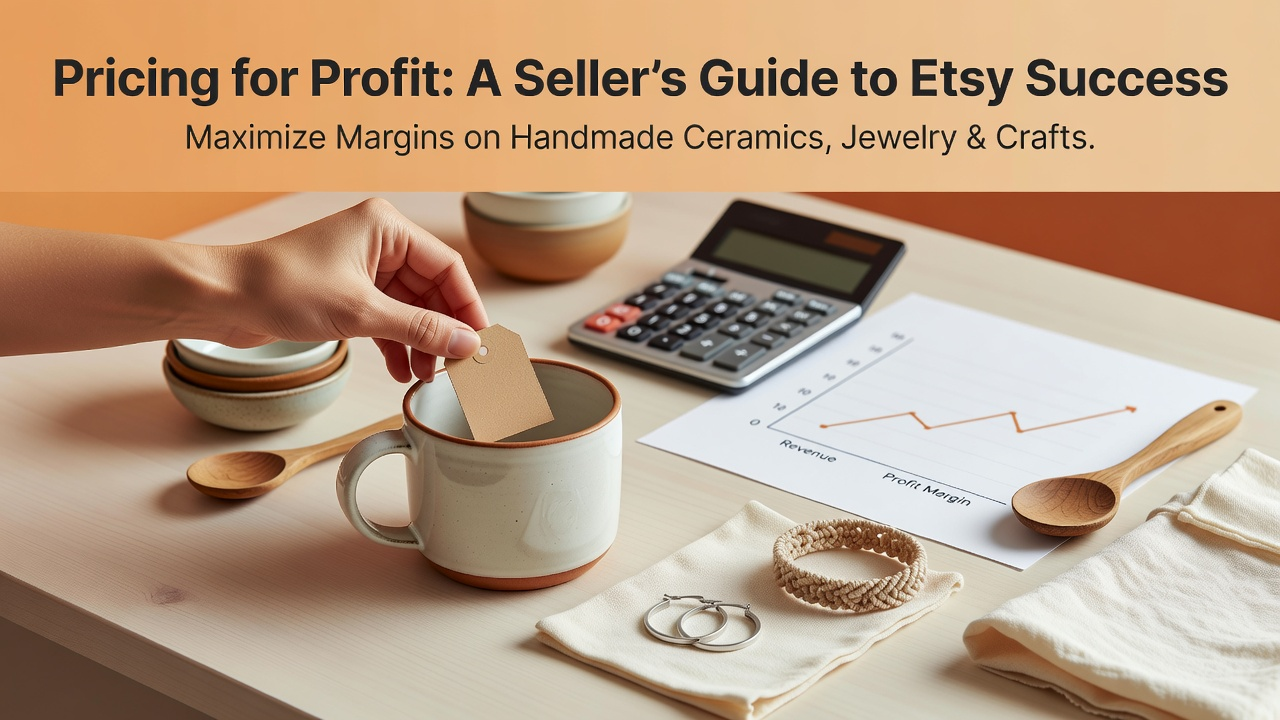
How to Price Etsy Products for Profit: A Complete Seller's Guide (2026)
Introduction
Imagine pouring hours into crafting that perfect handmade necklace, only to watch it sell for a price that barely covers your materials. Sound familiar? Most Etsy sellers fall into this trap, pricing based on what competitors charge or a quick gut feeling. But here's the truth: without a solid Etsy pricing strategy, you're not building a business—you're funding a hobby.
The real question every seller must ask? Am I actually making money on every sale, or just moving inventory? In this complete Etsy pricing guide, we'll break down how to price Etsy products for real profit. From uncovering hidden costs to testing prices that convert, you'll walk away with an Etsy pricing formula that works. Whether you're a newbie shop owner or scaling your handmade empire, these Etsy seller pricing tips will transform your margins.
The Real Cost of Your Etsy Product
Pricing starts here: knowing your true costs. Skip this, and your handmade product pricing will always fall short. Many sellers only tally materials, ignoring the full picture. Let's dissect every component so you can calculate Etsy profit pricing accurately.
Think of your product as an iceberg. Materials are the tip; everything else lurks below. Track these religiously for each item:
- Materials: Raw supplies like yarn, beads, or clay. For a knit scarf, that's $10 in wool—not just wholesale bulk, but per-unit cost including waste.
- Labor/Time: Value your hours. At $15-25/hour (your opportunity cost), a 2-hour bracelet build adds $30-50.
- Packaging: Boxes, tissue, labels—$1-3 per item. Eco-friendly options? Factor the premium.
- Shipping Supplies: Envelopes, tape, bubble wrap. USPS Priority? $2-5 extra.
- Etsy Fees: Transaction (6.5%), payment processing (3% + $0.25), listing ($0.20). Offsite ads can hit 12-15%. Dive deeper in our Week 1 guide: Etsy Fees Explained.
- Photography & Marketing: Camera gear amortized ($0.50/item), Etsy ads ($1-2), social promo time.
- Overhead: Tools, studio rent, utilities—divide by monthly output (e.g., $200/month / 100 items = $2/item).
Quick Checklist for True Costs:
- Log materials receipts weekly.
- Time yourself on 10 items; average it.
- Estimate fees using last month's sales.
- Add 10-20% buffer for surprises.
Master this, and your Etsy product pricing foundation is rock-solid. One seller I know rediscovered $8/item in hidden fees—enough to double her profit margin overnight.
The Etsy Pricing Formula
No more guesswork. The Etsy pricing formula is simple yet powerful: (Materials + Labor + Overhead + Etsy Fees + Desired Profit) = Minimum Price. This Etsy profit margin pricing ensures every sale builds wealth.
Minimum Price = Materials + Labor + Overhead + Etsy Fees + Desired Profit
Growing Beyond Marketplaces: When Your Pricing Strategy Needs Its Own Storefront
Once you have your true costs dialed in and a profit-tested price, the next growth lever is often not price — it's platform. Marketplace search, fee stacks, and limited email capture make it harder to build lifetime value from the pricing work you just did. Many sellers keep their Etsy shop while adding a standalone store to own the checkout and customer relationship. Shopify is a tool sellers use for that next stage.
Learn About ShopifyWe may earn a commission if you sign up, at no extra cost to you.
Let's apply it to a handmade ceramic mug. Assumptions: sells for $45, ships domestically.
| Cost Component | Amount | Notes |
|---|---|---|
| Materials (clay, glaze, kiln time) | $8 | Per mug |
| Labor (1 hour at $15/hr) | $15 | Throwing, firing, finishing |
| Overhead ($300/mo / 100 mugs) | $3 | Studio share, tools |
| Etsy Fees (6.5% + 3% + $0.25 on $43.50) | $5.50 | Estimate iteratively |
| Desired Profit (30% margin) | $12 | After all costs |
| Total Minimum Price | $43.50 |
Step-by-step math: Start with direct costs ($8 + $15 + $3 = $26). Add estimated fees (6.5% of price + fixed; solve iteratively or use a tool). Layer profit. Round up to $45. Boom—profitable pricing.
Tweak for your niche: Jewelry? Higher labor. Prints? Low materials. This formula scales.
Pricing Strategies That Work on Etsy
Costs covered? Now layer in strategies for your Etsy pricing strategy. These five proven approaches boost sales without slashing margins.
1. Cost-Plus Pricing
Build from our formula: Add 30-50% markup on costs. Etsy example: Soap maker costs $4/item, prices at $12 (200% markup). Reliable for beginners.
2. Value-Based Pricing
Charge for perceived value—your story, quality, uniqueness. A custom pet portrait? $75 because it's heirloom-level, not $20 commodity. Highlight in listings: "Hand-painted from your photo."
3. Competitive Pricing
Research 20 similar shops via Etsy search. Price at the upper quartile if your quality shines. Avoid race-to-bottom: If averages $28, go $32 with better photos/story. Tool tip: Use Etsy's "Shoppers also bought" for intel.
4. Psychological Pricing
$24.99 feels like a steal vs. $25. Charm pricing lifts conversions 10-20%. Etsy bundles: $49.99 for three candles vs. $50. Test on high-traffic listings.
5. Tiered Pricing
Good ($20 single earring), Better ($35 pair), Best ($55 set with case). Upsells average order value. Print shop example: Digital $5, Print $20, Framed $50.
Mix them: Cost-plus base, value tweak, psych polish. Watch sales soar.
Common Etsy Pricing Mistakes
Even savvy sellers stumble. Avoid these five pitfalls draining your Etsy profit pricing.
- Pricing Too Low to Compete: Undercutting to #1 search spot kills margins. Cost: 50% less profit. Fix: Focus quality; aim top 10% prices.
- Forgetting Labor: "It's my passion!" = free work. Cost: Burnout, no scale. Fix: Hourly rate minimum.
- Ignoring Fee Increases/Offsite Ads: Etsy's 2026 tweaks? Budget 15-20%. Cost: Surprise losses. Fix: Link fees to Week 1 guide.
- Ignoring Shipping in Price: Free shipping? Bake into product. Cost: Negative margins. Fix: Profile shipping calculator.
- Failing to Raise Prices: Costs rise; prices don't. Cost: Shrinking profits. Fix: Annual review +10%.
Spot these? Audit now. One fix can reclaim thousands yearly.
How to Test and Adjust Your Prices
Pricing isn't set-it-forget-it. Test like a pro for optimal handmade product pricing.
- A/B Test Variations: Duplicate listings: $29 vs. $34. Run 2 weeks; track views-to-sales.
- Monitor Metrics: Conversion rate >2%? Good. Drops? Revert. Use Etsy stats + Google Analytics.
- Watch Competitors: Monthly scan, but lead—don't chase.
- Seasonal Tweaks: Q4? +15-20% for holidays. Spring refresh: bundles.
- Raising Prices Smartly: 10% increments. Email loyalists: "Enhanced quality, same love." Grandfather VIPs. Announce: "Investing in premium materials."
Pro tip: Start small. One listing test informs all. Data beats doubt.
Using Smart Sellers Tool to Price Your Products
Ready for instant clarity? Smart Sellers Tool—Business Calculators for Online Sellers—removes guesswork with instant transparent math. Built for seller decisions, our tools deliver clear numbers before they commit.
Plug in costs, fees, profit goals. Get real-time feedback, transparent methodology, exportable reports. Perfect for Etsy pricing calculator needs.
- Etsy Pricing Calculator: Formula automated.
- Etsy Profit Calculator: Margin magic.
- Etsy Fee Calculator: Fee breakdowns.
- Etsy Break-Even Calculator: Sales targets.
Try now—scale smarter.
FAQ
What is a good profit margin for Etsy products?
Aim for 30-50% net profit after all costs. Handmade niches like jewelry hit 40%+ due to low materials. Mass-produced? 20-30%. Calculate: (Price - Total Costs)/Price. Under 25%? Reprice. Track quarterly; scale winners. Tools like Etsy Profit Calculator simplify. Sustainable margins fund growth, not just survival.
How do I calculate my Etsy product price?
Use: Materials + Labor + Overhead + Fees + Profit. Example: $10 mat + $20 lab + $2 oh + $4 fees + $15 profit = $51. Iterate fees. Test 10% above minimum. Smart Sellers Tool automates for accuracy across listings.
Should I include shipping in my Etsy price?
Yes for free shipping—boosts conversions 20%. Profile it separately for transparency. Bake USPS costs ($4-8 domestic) into item price. International? Profiles or calculated. Check fee impacts. Customers love predictability.
How often should I change my Etsy prices?
Quarterly reviews; annual raises of 5-10%. Test monthly on top sellers. Triggers: Cost hikes, Q4 surges, competitor shifts. Announce changes positively. Data-driven: If conversions hold, lock in.
What's the difference between wholesale and retail pricing on Etsy?
Retail: Full price to end buyers (your main Etsy gig, 2-3x costs). Wholesale: 50% off to resellers, min orders. Etsy suits retail; wholesale via separate channels. Margins tighter—40% target. List both if scaling.
Conclusion
You've got the blueprint: True costs, killer formula, smart strategies, mistake-proofing, testing, and tools. Pricing right turns Etsy side-hustles into empires. Start today—audit one product using the formula. Watch profits stack.
Grab Etsy Pricing Calculator for instant wins. Your profitable shop awaits.